
How to Search the Beaver County Court Docket
Utah Courts Xchange is where most Beaver County court docket searches begin. It pulls its data straight from CORIS. That is the state's case-management system, and it covers Beaver County District Court and the justice courts alike. Scope a search statewide, by county, or by a single courthouse. Don't confuse it with eFiling; that service is for registered filers sending papers in. Xchange shows public case information to people reading it. Parties in eligible cases get another option. The free MyCase service opens once they verify identity and case connection.
Feed the search the best fact you hold. A full case number, citation number, party name, court location, or rough filing date all work. A bare number can mislead, though. Utah warns that case and citation numbers are not unique statewide, so pair the number with Beaver County and the likely court. Felonies and broader civil matters usually start in Beaver District Court. Traffic, infractions, class B or C misdemeanors, ordinances, and small claims typically land in one of the three justice courts.
- Open Utah Courts Xchange and choose the public guest, account, or payment path.
- Select District Court, Justice Court, or both, then narrow the scope to Beaver County or a named court.
- Enter a case number or a party name. Add a case type or date range if the first search is broad.
- Check the county, court, case type, number, filing date, and party role before opening the history.
- Use the official calendar for a live setting, and ask the court clerk for a certified copy when authentication matters.
Beaver County Xchange Search Fields
Xchange gives you more than a name box. The help material lists fields for jurisdiction, search type, case number, party name, case type, court scope, citation number, and several date ranges. Name searches accept an asterisk wildcard. Put a company name in the last-name field. Common names can hit the 500-result ceiling, so filter by court, case type, or date to keep things manageable.
| Field | Best Beaver County Use | Caution |
|---|---|---|
| Jurisdiction | Choose district, justice, or both | Juvenile cases are not included |
| Case number | Pair the number with the named court | The first two digits mark filing year, not a full date |
| Party name | Use filed spelling and official wildcard tips | Do not copy private identifiers |
| Case type | Narrow criminal, civil, traffic, probate, or domestic results | A code is a category, not an outcome |
| Date range | Limit filing, disposition, or judgment dates | Each date describes a different event |
The official Xchange landing screen shows guest, payment, login, and new-account choices.
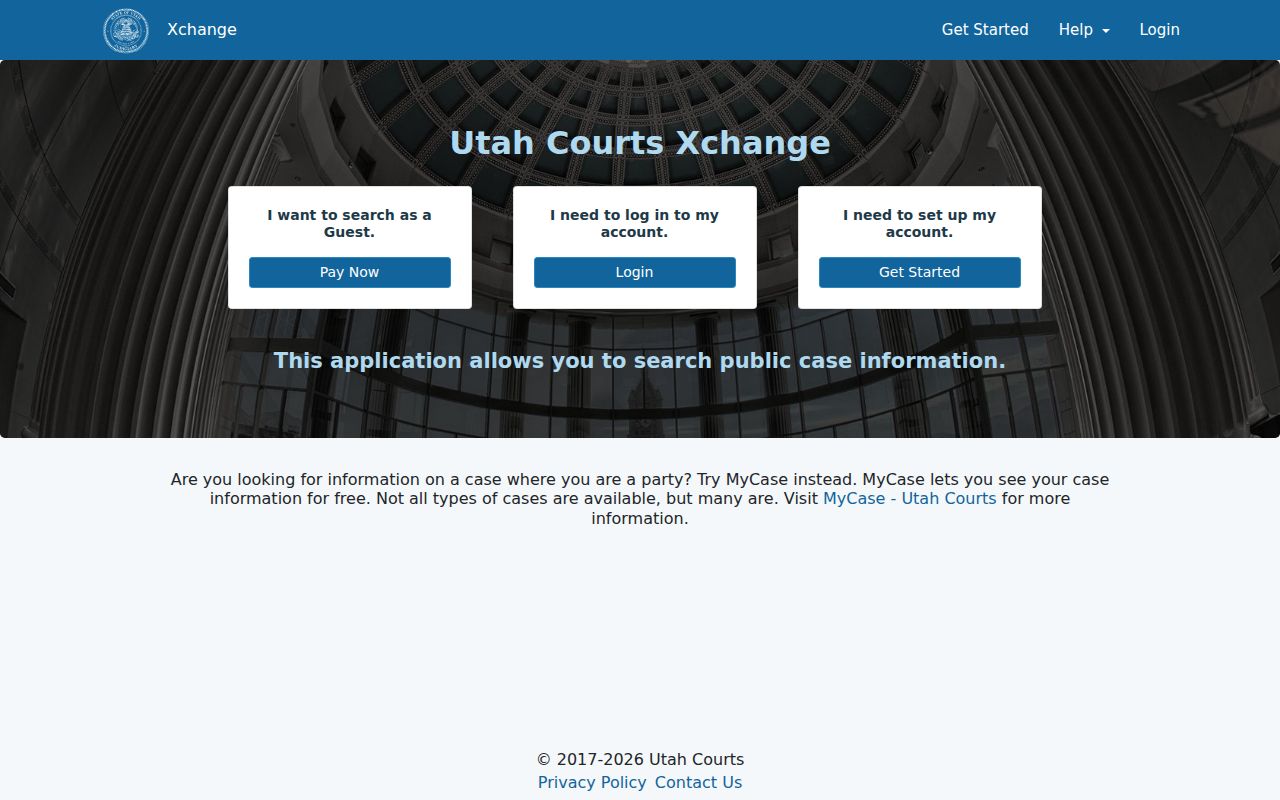
The separate choices sort out three situations. A one-time public search, an existing subscription, and a party's free MyCase access each have their own path.
What a Beaver County Court Docket Shows
Utah labels the online view a summary case history or extended case history. It identifies the court and case number. Filing date, type, caption, current judge, parties, attorneys, and the run of proceedings follow. A criminal history may add charges, classification, plea, disposition, citation data, and an accounting section. Civil histories can show filed events, party roles, judgments, and document links. Treat it as an index and event log. It does not promise that every paper is online.
| Case number | Copy the full Utah identifier exactly. The first two digits indicate the filing year. |
|---|---|
| Parties | Names appear with role codes such as PLA, DEF, PET, or RES and counsel when entered. |
| Proceedings | Chronological filings, hearings, minute entries, orders, and other court events form the case history. |
| Hearing settings | A setting may show a date and court event, but the live calendar should confirm current scheduling. |
| Court and judge | The record names its court location and current assigned or presiding judicial officer. |
| Disposition | The entered resolution must be read apart from the charge, plea, judgment, and payment fields. |
The official illustrated Xchange instructions walk through the fields and show how search results lead to case history and documents.
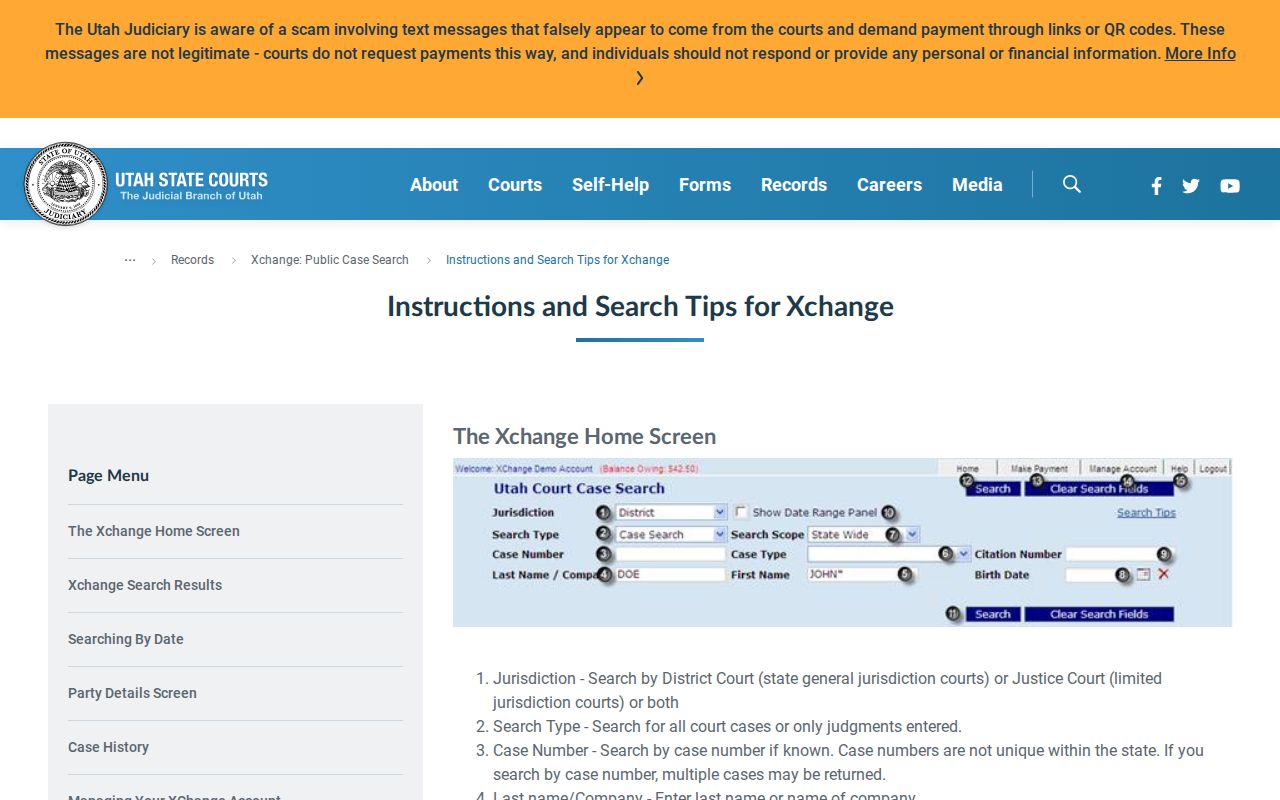
Those illustrated fields give the page inventory without exposing any private Beaver County party or an unsupported sample outcome.
Reading Beaver County Case Codes
Case codes help narrow a Beaver County court docket, but they never decide what happened. Utah's examples include FS for a state felony. MD is misdemeanor DUI, and MO is another misdemeanor. IF marks an infraction, TN a traffic citation, and TC a traffic court case. Civil codes span contracts, debt collection, and property rights. Automobile torts, domestic cases, estates, guardianships, and name changes fill out the list. Use the code as a filter only. Then read the caption and the events.
- Proceeding
- A dated court event, which may be a filing, hearing, order, or minute entry.
- Disposition
- The recorded resolution of a charge or case event. It is distinct from a filing or hearing date.
- Judgment
- An order or outcome recorded in the history, sometimes followed by a later satisfaction status.
- Accounting
- The part of an eligible history that lists assessed amounts, payments, trust, or balances.
A charge entry does not prove a conviction. Check plea, disposition, and judgment separately, and turn to the official Utah code list when an abbreviation is unclear.
Which Beaver County Courts Keep Dockets
Utah has no single county clerk docket division. Each court keeps its own case record. Beaver District Court is the general-jurisdiction trial court. Beaver, Milford, and Minersville Justice Courts hold their precincts' limited-jurisdiction matters. Juvenile files sit with the Fifth District Juvenile Court clerk under special access rules. The Beaver County Clerk/Auditor keeps county administrative records, not these judicial dockets.
| Court | Docket Covers | Where to Search |
|---|---|---|
| Beaver District Court | General civil, felony and class A criminal, domestic, probate, and justice-court appeals | Xchange, calendars, courthouse terminal, or district clerk |
| Beaver Justice Court | Beaver precinct traffic, infractions, class B/C misdemeanors, ordinances, and small claims | Xchange, calendars, county forms, or local clerk |
| Milford Justice Court | Milford precinct limited-jurisdiction cases | Xchange, calendars, or Milford clerk |
| Minersville Justice Court | Minersville precinct limited-jurisdiction cases | Xchange, calendars, or Minersville clerk |
| Fifth District Juvenile Court | Delinquency, child welfare, termination, and related juvenile matters | Direct court contact subject to access rules |
A justice-court appeal can spawn a separate district court record. State appellate review belongs to the Utah Court of Appeals or the Utah Supreme Court. Federal and bankruptcy records use PACER, not Xchange.
Beaver County Docket Access Paths
Remote search is only one route. Xchange charges most public researchers. But a free public Xchange terminal sits at most district courts and may exist at some justice courts. Call first to confirm terminal access. A party to an eligible case can use MyCase for case history and filed papers. When an item is not online, submit Utah's written Request for a Court Record. Send it to the court holding the file.
Phone and counter service still matter. Beaver District Court handles its own civil and criminal files, and each justice court answers for its own precinct. Mail requests go to the named court too, never the County Clerk/Auditor. For an old district matter, the Utah State Archives can bridge modern Xchange coverage and the historic index books.
Routing rule: use the court location printed on the citation or shown in Xchange. A Milford or Minersville record does not move to Beaver merely because all three courts serve the county.
Finding Beaver County Court Dates and Settings
Utah Court Calendars and Xchange do different jobs. Xchange holds the case history. Calendars show scheduled activity. You can search it by location, case number, party, judge, attorney, or date. The state refreshes the calendar data on weekdays around 5:30 a.m. Read a hit with care. A listed setting does not prove a hearing happened. An empty result does not prove the case is gone.
Pick your court with care too. Beaver District Court and Beaver County Justice Court each keep their own docket, so choose the right one, note the date and location shown, then check the result against Xchange. A reset or continuance can move a future hearing before the finished minute entry lands in the case history. The Beaver County Court Calendar walkthrough explains the official filters and confirmation steps. If timing is tight, call the clerk whose calendar holds the event.
The Utah Court Calendars page posts the statewide search controls along with its update notice.
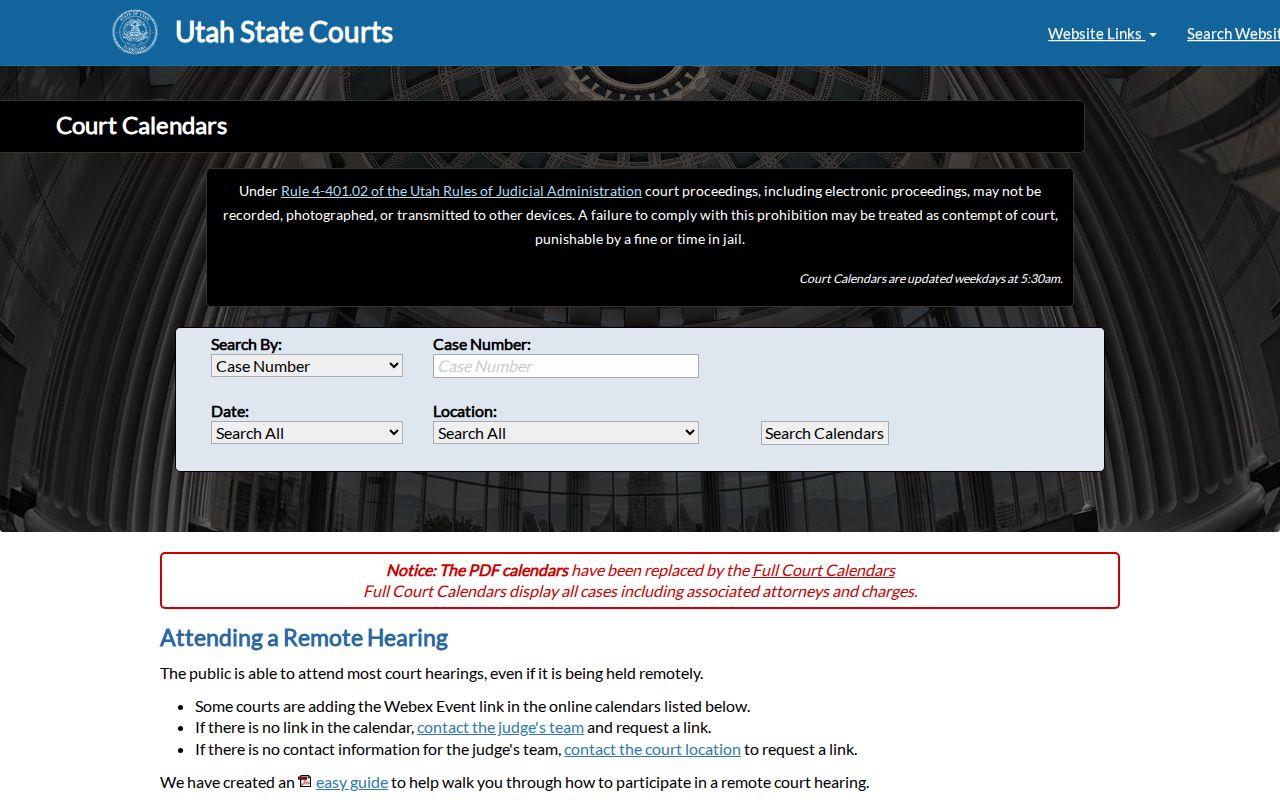
Think of this screen as a calendar tool. Read it beside the case history and any current instructions from the court you selected.
Beaver County Docket Volume
Court level and category drive the numbers here. Official FY2023 statistics show Beaver County Justice Court logging 3,570 filings and 4,381 dispositions. Traffic accounted for 3,394 of the filings. The 123 percent clearance rate divides dispositions by filings for that period. It is not a conviction rate. A court can clear more than 100 percent when it resolves matters filed in an earlier period.
A later count showed 132 active pending matters at Beaver District Court on January 2, 2026. That figure measures pending matters at one stated time, just as other tallies measure filings or dispositions. None of these numbers can be recast as a count of people or of current cases.
Public Access to Beaver County Court Dockets
Utah starts from a presumption that court records are public. Court rules still classify some information as private, protected, sealed, or otherwise restricted. Xchange leaves out sealed and expunged cases. It also omits juvenile matters, adoptions, civil mental-health commitments, child-welfare and termination cases, and certain private domestic or probate documents. A missing result can stem from access rules, coverage gaps, or a search choice. It never proves no filing exists.
Key Rules:
UCJA Rule 4-202.02 classifies court records as public, private, protected, sealed, or another stated class.
UCJA Rule 4-202.03 sets who may obtain records in each access class.
Utah Code § 63G-2-201 states a public inspection baseline while recognizing the separate rules that govern judicial records.
Restricted material is available to authorized people. They must state the legal basis and supply any required proof. Public users should not guess at hidden facts from a redaction, and a home address in a filing does not make it fair game to repeat.
Older Beaver County Docket Books
Beaver District Court joined the modern statewide system on August 17, 1998. Records from before that date can be spotty. Utah State Archives offers three browse-only Beaver County index volumes: defendant and plaintiff indexes covering 1896 through 1950, plus a combined index for 1950 through 1998. These are images to page through. They are not a name-search database. An index hit is a lead to a file or microfilm reel, not the full certified court record.
- Check Xchange first and note any coverage gap.
- Browse the correct Archives index by role and period.
- Record the name as written, volume, page or image, year, and case number if shown.
- Ask the Utah State Archives or holding court for the underlying series.
Territorial Second District materials and later Fifth District files may sit in separate archival series. When searching, court, year, and party role work better than a modern city label alone.
The Beaver County Clerk and Docket Records
Record custody splits by court. The Beaver District Court clerk or judicial services representative holds district civil, criminal, domestic, probate, and appeal records. Justice court clerks keep their own local dockets. That division matters for certified copies, corrections, recordings, and anything unavailable online. The court record request process covers inspection, ordinary copies, and an explanation field for requesters claiming authorized access to nonpublic material.
Beaver District Court Clerk
2270 South 525 West
Beaver, UT 84713
(435) 438-5309
Milford Justice Court
26 South 100 West
Milford, UT 84751
(435) 387-5571
Call first because official local pages show conflicting addresses.
Minersville Justice Court
60 West Main Street
Minersville, UT 84752
(435) 386-2586
Published fees are straightforward. Paper sheets run 25 cents each, a certified document costs $4 plus 50 cents per page, and an exemplified document runs $6 plus 50 cents per page. Ask the clerk for a current estimate before ordering. Audio and video requests use their own Fifth District form and fee schedule.
Beaver County Court Record Costs
The cheapest route depends on the record. Inspection can be free. A courthouse terminal avoids the remote Xchange search charge, while an available Xchange document carries a flat remote purchase fee. Certified court copies cost more because the clerk authenticates them. Staff preparation can add cost after the published free interval, so a narrow request with a case number and document date saves money and time.
| Item | Published charge | Route |
|---|---|---|
| Inspect a public record | No ordinary inspection charge stated | Holding court or available terminal |
| Paper copy | $0.25 per sheet | Court records request |
| Certified copy | $4 per document plus $0.50 per page | Holding court clerk |
| Xchange guest account | $10 account, $0.20 per search, $1 per document | Xchange public service |
Utah publishes other charges too. Those cover electronic media, fax or email delivery, staff time, recordings, and exemplified copies. A requested format may be refused when the same document is already available through Xchange.
Beaver County's Historic Courthouse
Beaver County's 1882 courthouse explains the county's long record history, but it is not the address published for current Fifth District hearings. The historic building rises three stories. Its black volcanic-rock basement sits beneath red brick, a four-faced clock tower, later vaults, and a pink-sandstone jail addition. Current Beaver District Court and Beaver Justice Court operations are listed at 2270 South 525 West. The official Beaver County history page preserves details about the old courthouse and its construction.
That distinction keeps a historical landmark from being mistaken for today's docket counter or hearing location.
Court Dockets by City in Beaver County
Beaver, Milford, and Minersville are the three incorporated communities covered here. Their limited-jurisdiction matters route through separate justice courts. There are not three independent city docket portals. Population figures help identify the communities but say nothing about where a case was filed, so rely on the court location on the citation or the Xchange result.
Beaver Court Docket
2020 population 3,592 · Beaver Justice Court is the local limited-jurisdiction route.
Milford Court Docket
2020 population 1,431 · Call Milford Justice Court to resolve the published address conflict.
Minersville Court Docket
2020 population 807 · Minersville Justice Court keeps its local case history.
None of the three cities runs its own public municipal case database. The working search chain is Xchange, the Utah calendar, and the named justice court clerk.
Map and Directions to the Beaver District Court
General-jurisdiction civil and criminal cases in Beaver County are filed with the Beaver District Court, Fifth Judicial District, at 2270 South 525 West in Beaver. The same building holds the Beaver Justice Court, so a visitor should confirm whether the file is a district or justice-court matter before asking at the counter. This current address is not the county's 1882 courthouse at 105 East Center Street, which is now the county administrative offices rather than a hearing location.
Beaver District Court Clerk
2270 South 525 West
Beaver, UT 84713
(435) 438-5309
Monday through Friday, 8:00 a.m. to 5:00 p.m.
The court does not close for lunch, but no official source publishes courthouse parking, security-screening, or ADA-route details, so call ahead for accommodation or access questions. Courtroom proceedings may not be recorded, photographed, or transmitted under Utah court rule.