
Searching Cases by Name
For a public Beaver County case search by name, the main service is Utah Courts Xchange, which covers district and justice courts. Pick the jurisdiction first. Then type the name. Beaver District Court handles general civil, felony, class A misdemeanor, domestic, and probate matters, while the Beaver, Milford, and Minersville Justice Courts each keep their own limited-jurisdiction case histories.
- Choose District Court, Justice Court, or both, then narrow the scope to Beaver County or the likely court location.
- Enter the last name as filed. Add an asterisk wildcard; use a first-name prefix plus an asterisk to catch middle names, initials, or suffixes.
- Put a business name in the last-name/company field. Try versions with and without LLC, Inc., or Co.
- Add a case type and a filing, disposition, or judgment date range when the result set is broad.
- Open the result and confirm county, location, case type, case number, filing date, party name, and party code.
- Broaden filters and call the correct clerk before treating a blank result as evidence that no case exists.
The field list does not flag any input as required, so the live system decides what it will accept. Each Xchange search costs money. Do not enter or republish a birth date or address unless the search truly needs it.
| Field | Type | Required | Beaver County use |
|---|---|---|---|
| Jurisdiction | Selector | Unspecified | District, Justice, or both |
| Search Type | Selector | Unspecified | All cases or judgments only |
| Last Name/Company | Text | Optional | Name as filed; wildcard advised |
| First Name | Text | Optional | Prefix plus wildcard can broaden variants |
| Case Type | Selector | Optional | Civil, criminal, traffic, domestic, probate, and more |
| Search Scope | Selector | Optional | Statewide, Beaver County, or one court |
| Date Panel | Ranges | Optional | Filing, disposition, judgment, or judgment disposition |
Beaver Xchange Entry Paths
Xchange splits its landing screen into guest search, payment, account login, and account setup. Guest access is the fastest way to start. A one-time guest session carries a $10 account fee. It adds $0.20 per search and $1 for each public document you open. The session runs 24 hours but can expire after 30 minutes of inactivity. Subscribers pay differently. Setup is $25, then $40 per month. That includes 500 searches, then $0.35 per search beyond that. Documents still cost $1. The official Xchange landing screen lays out these entry choices for a Beaver County search.
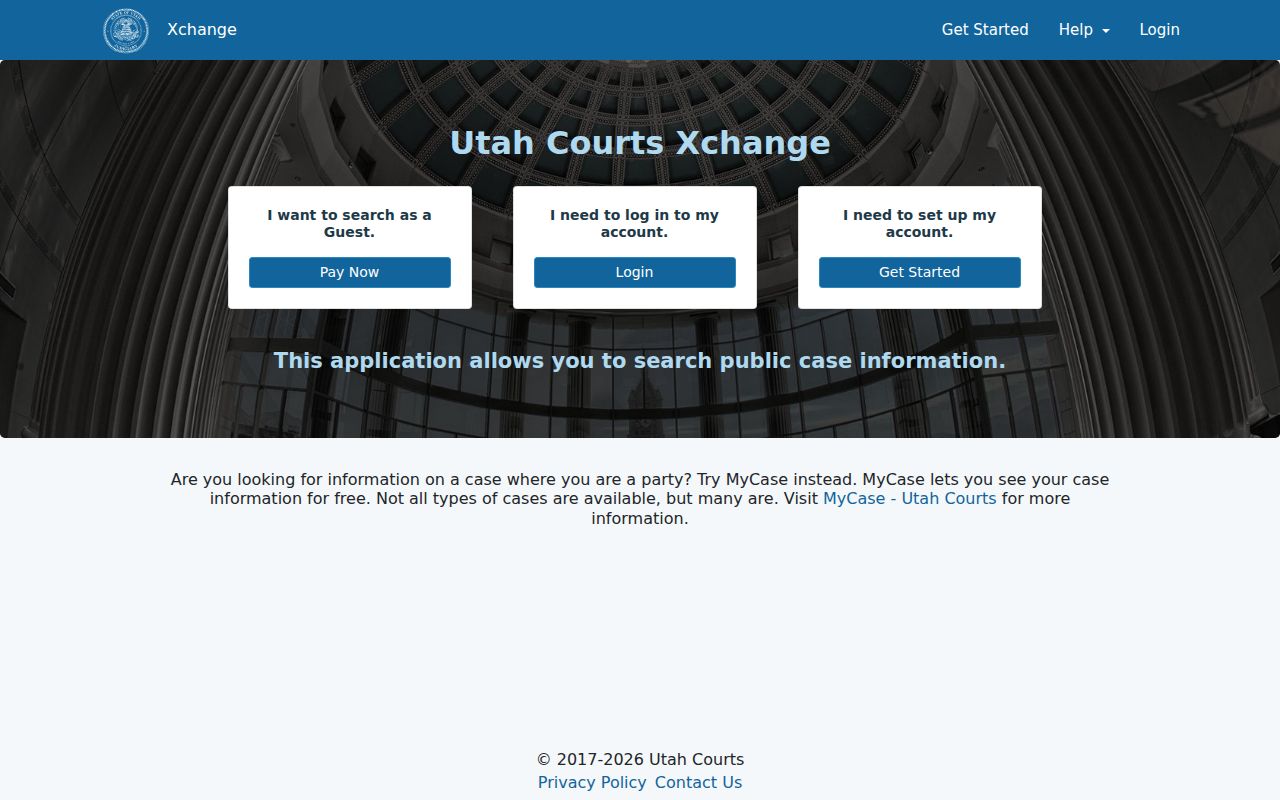
The split matters in practice. Pay Now and Login are account actions. Guest and account setup are the ways a public researcher gets started.
Eligible parties should also look at MyCase. It is free. Once your identity is verified, it can show case history, filed papers, payments, and linked cases. It is not an anonymous statewide search, and it does not cover every case type. Utah eFile serves registered filers, not the general public looking for a Beaver County lookup.
Searching by Case Number
A case number beats a name for accuracy. Xchange warns that numbers are not unique statewide. The first two digits give the filing year. So a local format looks like YY + court-assigned remainder rather than any invented Beaver County number. Copy the real identifier exactly and pair it with Beaver County and the court location.
Citation numbers are not unique statewide either. Pick the justice court printed on the citation. Then confirm the court in the result row. Clicking a case number opens the extended history rather than going straight to documents. The separate case-history/documents link opens summary information plus any purchase path for available papers. Filing year, violation date, hearing date, disposition date, and judgment date are separate fields. They should never be merged.
Beaver Xchange Search Controls
The help page maps every field that shapes a Beaver County lookup. Search Scope can run statewide, county-wide, or court-specific. Case Type covers codes for felony, misdemeanor, infraction, traffic, civil, domestic, probate, judgment, and appeal records. A toggle opens date filters. One caution: Search itself starts a billable query. Home, Make Payment, Manage Account, and Help handle account and navigation tasks. The official illustrated Xchange instructions show the full field layout.
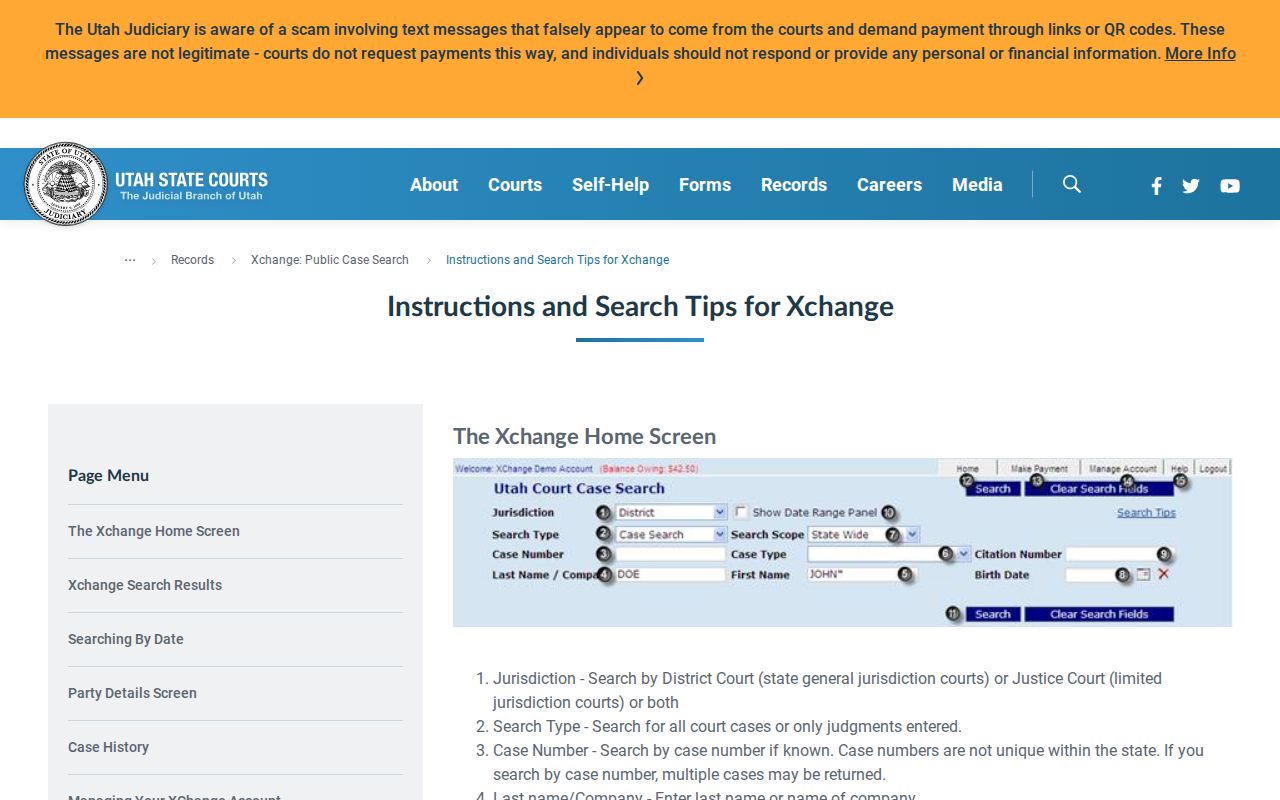
The illustration documents the fields themselves. It makes no claim that a private Beaver County party or sample case was searched.
| Additional field | Type | Required | Format or note |
|---|---|---|---|
| Case Number | Text | Optional | First two digits indicate year; pair with location |
| Birth Date | Date/text | Optional | Use only when necessary; do not publish |
| Citation Number | Text | Optional | Not unique statewide |
| County | Scope option | Optional | Select Beaver |
| Court Location | Scope option | Optional | District, Beaver, Milford, or Minersville Justice |
| Search | Button | Action | Starts a billable search |
What a Case Search Returns
A Beaver County result row works like a compact index. The extended history adds the chronological record plus category-specific details. Read the row before paying for documents. A common name can return up to 500 records. So confirm the Beaver County location twice: once in the search scope and again in the row.
| County and Court | Beaver County and the precise district or justice location. |
|---|---|
| Case Number | The exact identifier that links to extended history. |
| Party and Code | The filed name and role, such as plaintiff, defendant, petitioner, or respondent. |
| Case Type | The Utah category code for the case. |
| Filing Date | The date entered or filed, not the event or disposition date. |
| Charges | Description, level, attributes, plea, and disposition when present in criminal history. |
| Proceedings | Chronological events and minute entries. |
| Documents | Available public PDFs, purchased separately at the published price. |
| Accounting | Revenue, trust, fines, fees, paid sums, and balances when shown. |
| Judgment | Codes and dates that require the official disposition-code list. |
A charge alone proves nothing about guilt. A plea is not a disposition, and a disposition is not always the same event as judgment satisfaction. Check the applicable block and its date before describing any outcome.
Narrowing Beaver Name Results
Xchange caps results at 500. If a Beaver County name search hits that ceiling, narrow it down. County, precise court, case type, or date all trim the list. Add a first-name prefix only after checking how the name may have been filed. For a business, test suffix variants. Never force a match with a birth date. Court and case data can tell the records apart.
More than 500 records: Narrow to Beaver County, choose District or Justice Court, add the likely case type, and set a defensible date range.
No results? Work in reverse. Remove an uncertain date or type, choose both jurisdictions, test a wildcard, and call the clerk. Xchange support at xchange@utcourts.gov can fix system problems, but only the court clerk can correct official case data.
Statewide vs County Case Search
Beaver County keeps no separate full docket database of its own. The county Justice Courts site offers contacts, forms, and payment routes. Statewide Xchange supplies the public district and justice case history. MyCase is a third route. It serves a verified party. A free courthouse terminal may also offer public Xchange access.
| Channel | Coverage | Best use |
|---|---|---|
| Xchange | Public Utah district and justice histories | Name or number search across Beaver County |
| MyCase | Eligible cases linked to a verified party | A party's own history and filed papers |
| County court pages | Local contacts, plea forms, and payment guidance | Finding the correct justice clerk |
| Courthouse terminal | Public CORIS/Xchange data where available | Free in-person public search |
| Court clerk | The official file held by that court | Missing data, copies, corrections, and older records |
Federal District of Utah and bankruptcy records live in PACER, not Xchange. Older Beaver records may sit with the Utah State Archives. These boundaries keep a statewide state-court search from turning into a false all-courts search.
Beaver Cases Before Xchange
Beaver District Court joined CORIS on August 17, 1998. Older electronic records may be thin. For earlier Beaver County court docket material, the Utah State Archives keeps browse-only index books. Defendant and plaintiff volumes run from 1896 through 1950. A combined volume covers 1950 through 1998. An index entry is only a lead. It is not a full file, and it is not certified.
Start your docket search in Xchange. Then browse the archive volume that matches the era you need. Write down the spelling and party role. Add the case number, image or page, and the approximate year. The Archives or the holding court can supply the microfilm or transferred series behind the entry. Territorial Second District files run from 1870 through 1896. They travel a separate archival route.
Access and Restricted Cases
Utah access rules treat many court records as public. Xchange still hides sealed or expunged cases. Adoptions, mental-health commitments, juvenile cases, child-welfare matters, and termination cases stay hidden too. Some domestic and probate histories stay public while certain documents inside them remain private. A blank Beaver County search can mean several things. It may reflect access limits, gaps in coverage, a spelling problem, or simply the wrong court.
If the law allows you to ask, use the court record form. State your basis for private, protected, or sealed access. Attach the proof required by UCJA Rule 4-202.03. Redaction does not mean a dark secret. Do not infer hidden facts or republish personal data. A case turns up. The Beaver County court records process sorts out inspection, plain copies, certified records, audio, and transcripts.
Beaver Federal Case Boundaries
A Beaver County address does not put every dispute in Utah state court. Federal civil and criminal cases live elsewhere. They sit in District of Utah PACER/CM-ECF. Bankruptcy takes a different route. It goes through the Utah Bankruptcy Court's own federal system. Federal appeals climb to the Tenth Circuit, not the Utah Court of Appeals. None of these appear in Xchange.
When you search PACER, pick the District of Utah. Search by party or federal case number. A secondary source can sometimes help you spot an entry worth a closer look. Before acting on any detail, check it against PACER or the federal clerk. State justice-court appeals that land in Beaver District Court stay inside Utah's system. Let the court name and case type guide your route.