
How to Get Court Records
Every court in Beaver County keeps its own files. The Beaver District Court clerk holds district civil, criminal, domestic, probate, and justice-appeal records. The Beaver, Milford, and Minersville Justice Courts keep limited-jurisdiction files. Each clerk holds the files for its own town. The county Clerk/Auditor and the Recorder hold other county records, not judicial case files.
- Identify the court, case number or caption, date range, and exact docket entry, paper, order, judgment, or hearing needed.
- Run a Beaver County case search in Xchange when the case is public and covered, or use MyCase when requesting access as an eligible party.
- Choose inspection, Xchange download, clerk-counter service, telephone guidance, email, or a written request sent by mail to the court holding the file.
- State whether a plain, certified, or exemplified copy is required. For audio or video, identify the hearing date, time span, judge, and courtroom.
- Ask for a fee estimate and current payment directions. Do not send written credit-card data on the Fifth District recording form.
- Review the result for redactions, certification, page count, and the precise Beaver County case before relying on it.
Calling works. Beaver District Court is at (435) 438-5309. Beaver Justice Court is at (435) 438-6470, Milford Justice Court at (435) 387-5571, and Minersville Justice Court at (435) 386-2586. Mail for the district court goes to PO Box 1683, Beaver, UT 84713. For the justice courts, Beaver uses PO Box 387. Milford uses PO Box 922, and Minersville uses PO Box 268.
Beaver Written Record Requests
Utah has one written process for this. The Utah Request a Court Record process lets anyone ask for public court records. The written request should name the Utah Judiciary office that will receive it. It must also describe the record with reasonable specificity. You can ask to inspect or get copies. You can also claim a listed fee waiver, explain your authority for a nonpublic record, or ask for expedited handling when the rule allows it.
Expect a response within ten business days. That clock covers the answer, not the copies. Classification review, redaction, retrieval, staff research, a broad description, or a fee estimate can all add time. The clerk may narrow your request. Or the clerk may point you to Xchange if the public document already sits there.
The official Utah court-record request instructions lay out the Beaver County route and the published charges:
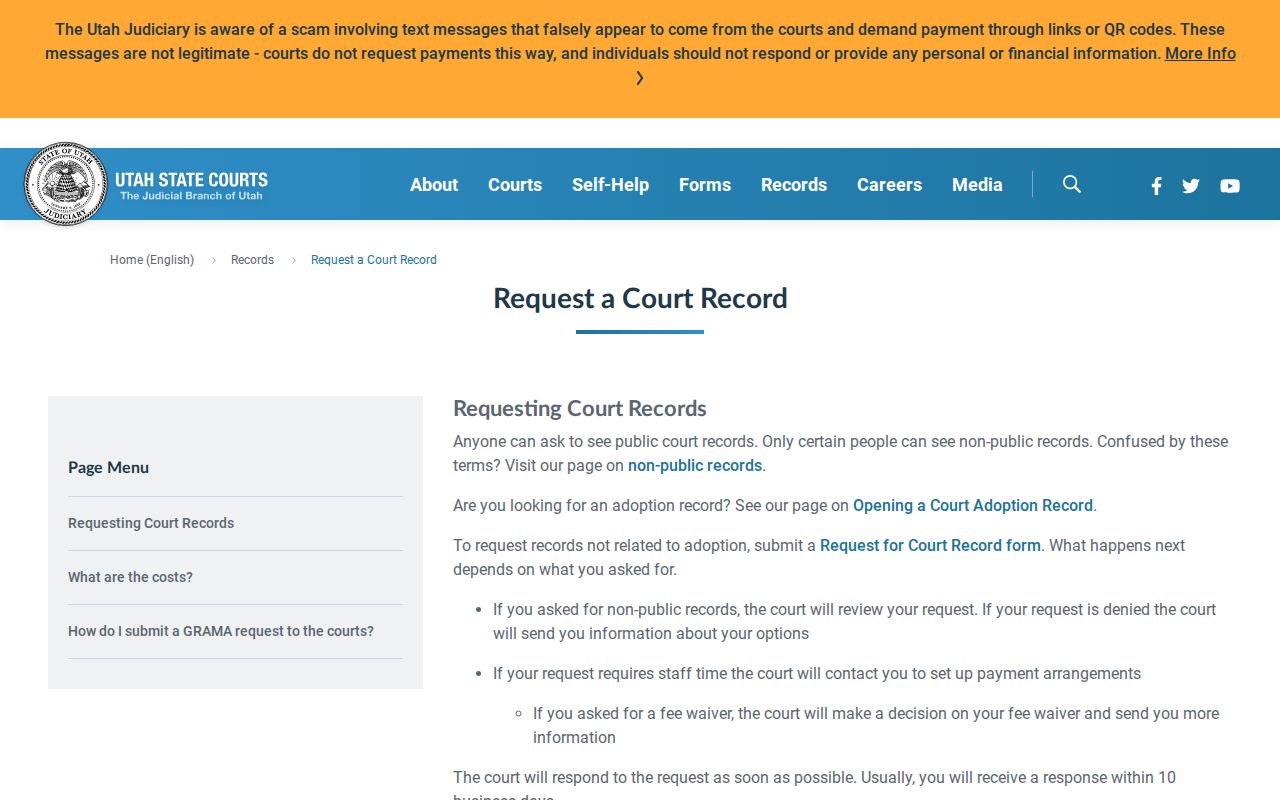
Beaver Written Record Requests: The court uses one assigned court-record form for written requests.
A separate PDF request form, a certified-fee page, and a recording form sit on the clerk's side of the counter; ask the clerk which one your Beaver County case lookup needs.
Types of Beaver Court Records
A case history is one layer of a Beaver County file. Match the request to your legal need. Some records sit in public Xchange, some must come from the clerk, and some turn on your authority to see them.
- Summary or extended case history, including parties, proceedings, disposition, judgment, and accounting fields.
- Pleadings and filed papers, such as complaints, petitions, answers, motions, and responses, when public.
- Signed orders, decrees, letters of appointment, and judgments.
- Certified or exemplified copies authenticated by the court clerk.
- Authorized digital audio or video of a proceeding, which is different from a written official transcript.
- Historical indexes, microfilm, or transferred files held through the Utah State Archives.
Not everything belongs in a public docket search. Juvenile, adoption, civil mental-health, child-welfare, termination, sealed, and expunged material stays out of ordinary Xchange content. A domestic or probate case may show a public history while its supporting papers remain private.
Beaver Court Record Custodians
The court named in the case result controls the request. Beaver District Court keeps general-jurisdiction records plus trial-de-novo and other justice-court appeal files. Justice clerks hold traffic, infraction, class B and C misdemeanor, ordinance, and small-claims cases. Each covers its own precinct. Juvenile files go to the Fifth District Juvenile Court clerk. Special access rules apply.
Beaver District Court Clerk
2270 South 525 West
Beaver, UT 84713
Mail: PO Box 1683
(435) 438-5309
Milford's addresses conflict. The official county directory lists 26 South 100 West, while a city public-safety page gives 451 North Main, so call the Milford clerk before you drive out. Minersville Justice Court sits at 60 West Main Street. A shared building or county name never merges custodians.
Note: Send Beaver County court-record requests to the court clerk, not the county Clerk/Auditor or Recorder.
What a Court Record Contains
A Beaver County court record can hold index data, chronological entries, filed documents, rulings, and financial information. Contents shift with the case type and access class. Xchange's official help illustrations list the fields without using a private Beaver County sample case.
| Header | Court, county, case number, filing date, case type, caption, and assigned judge. |
|---|---|
| Parties | Names, role codes, attorneys of record, and public details entered in the file. |
| Charges | Description, level, attributes, plea date and nature, and disposition data in criminal histories. |
| Proceedings | Chronological events, minute entries, settings, filings, orders, and other activity. |
| Documents | Available public filed or court-generated records; not every listed event has a downloadable PDF. |
| Accounting | Revenue, trust, fines, fees, payments, and balances when displayed. |
| Judgment | Judgment or disposition code and description; later satisfaction may have a separate date. |
| Certification | A clerk authentication added when a certified or exemplified copy is ordered. |
Read entries with care. A charge is not a conviction, and a filed motion is not a ruling. When the exact result matters, check the signed order or certified judgment too.
Beaver Audio and Transcripts
Beaver audio requests run through the Fifth District form, which routes them to beavercopies@utcourts.gov. Fill in the case caption and case number. Add the hearing or trial date, start and end time, judge, courtroom, your contact details, and delivery choice. A digital-audio CD costs $10. Video costs $15. The form requires advance payment, allows up to ten days to fill a request, and holds completed copies for 60 days. The general page separately lists audio or video at $15 per half-day, so ask which schedule controls.
An electronic recording is not an official transcript. Utah Courts sends transcript requests through the assigned transcriber or judicial-services channel, and you may have to arrange and pay that transcriber yourself. Making your own courtroom recording is no substitute. UCJA Rule 4-401.02 restricts recording, photography, and transmission of judicial proceedings.
Certified Copies and Fees
Know which copy you need. A plain copy just reproduces the record. A certified copy adds the clerk's authentication. An exemplified copy carries a more formal one. State the level in your first request, since a downloaded Xchange PDF is not automatically certified. Fees can change, so recheck the May 2026 fee page before paying.
| Item | Published amount or rule |
|---|---|
| Inspect public record | No ordinary inspection charge on the request form |
| Paper copy | $0.25 per sheet |
| Fax or email | $5 up to 10 pages; $0.50 each later page |
| Electronic storage medium | $15 per unit |
| Certified copy | $4 per document plus $0.50 per page |
| Exemplified copy | $6 per document plus $0.50 per page |
| Xchange document | $1 per available public document |
| Staff preparation | First 15 minutes free; role-based hourly fees may follow |
The court will not fax or email a record already in Xchange. Broad Beaver County requests can trigger search and redaction labor charges. Narrow the court, case number, document title, and date range to keep the staff route cheap.
Beaver Records by the Numbers
The Beaver County Justice Court reported 3,570 filings and 4,381 dispositions for FY2023. Traffic dominated the docket, at 3,394 filings. Misdemeanors added 166, while small claims brought just 10. Divide dispositions by filings for the period and you get a clearance rate of 123%, which can run high because matters resolved that year may have been filed earlier. That figure describes workflow, not outcomes. It is not a conviction rate.
Count filings and dispositions for what they are. They are not unique people. And they do not measure what sits open on the Beaver District Court docket today. A separate January 2026 report put active pending matters in that court at 132. So attach the period, the court level, and the measure to every number before you quote it.
Older Beaver Court Records
Older Beaver County court records take patience. Beaver District Court did not join CORIS until August 17, 1998, so earlier electronic entries may be thin. For deeper history, the Utah State Archives holds three browse-only Beaver indexes: plaintiff and defendant volumes covering 1896 through 1950, plus a combined volume for 1950 through 1998. Territorial Second District material from 1870 through 1896, along with older Fifth District files, may survive only on microfilm.
Work Xchange first. Then browse the index and copy the name exactly as written, plus the party role, page or image, case number, and approximate year. With that in hand, request the microfilm or transferred file itself. Remember that an index citation is not the full record, and it cannot be certified as though it were the original case file.
Public Access and Sealed Records
Judicial records in Beaver County answer to Utah court rules. They do not answer to a county GRAMA office. What stays public varies. Indexes, case status, violation and disposition data, daily calendars, public history, and public filings are generally open. Private, protected, sealed, and expunged records carry limited access. An authorized requester lists the legal basis on the written form and attaches proof. Even so, never assume a Beaver County court record is public just because a partial docket search returned one visible field.
Key Utah access rules:
UCJA Rule 4-202.02 classifies court records as public, private, protected, sealed, or otherwise restricted.
UCJA Rule 4-202.03 identifies who may access each class and what proof may be required.
UCJA Rule 4-202.08 governs court-record information, service, and fee handling.
UCJA Rule 4-202.09 addresses certified copies and other access provisions.
Utah GRAMA sets a baseline for inspection. Yet it respects the boundaries that judicial rules draw. A county or city records officer cannot stand in for the court clerk. The clerk actually controls the Beaver County court docket. Treat any sealed or expunged matter with care. And do not copy personal details from a file simply because one field happened to be visible.